
Governance Architecture
Built for environments where accountability matters.
Governance Architecture is the foundation of GABE HRIS. It defines how workforce decisions are created, approved, recorded, and preserved. Instead of treating governance as reporting after the fact, GABE embeds accountability directly into operational workflows.
Enterprise governance for workforce decisions
GABE HRIS is designed for regulated environments where workforce decisions must be explainable, provable, and preserved. The governance architecture ensures decisions can withstand audits, investigations, and internal review without disrupting operations.
System of record, not activity logs
GABE does not simply log actions. It preserves the context of decisions, including approvals, supporting evidence, and justification. This transforms HR data into a defensible system of record.
Policy-aware workflows
Workflows are aligned to policies and governance rules so approvals, escalations, and controls reflect how decisions are supposed to happen, not just how they happened once.
Immutable decision history
Where required, GABE preserves audit-grade decision history so changes are traceable and prior states remain reviewable.
Audit-ready by default
Evidence, approvals, and decision paths are captured continuously so audit preparation is an outcome of daily operations, not a special event.
How governance is operationalized
The diagram below illustrates how policies, approvals, decisions, evidence, and audit trails are connected within the GABE HRIS governance architecture.
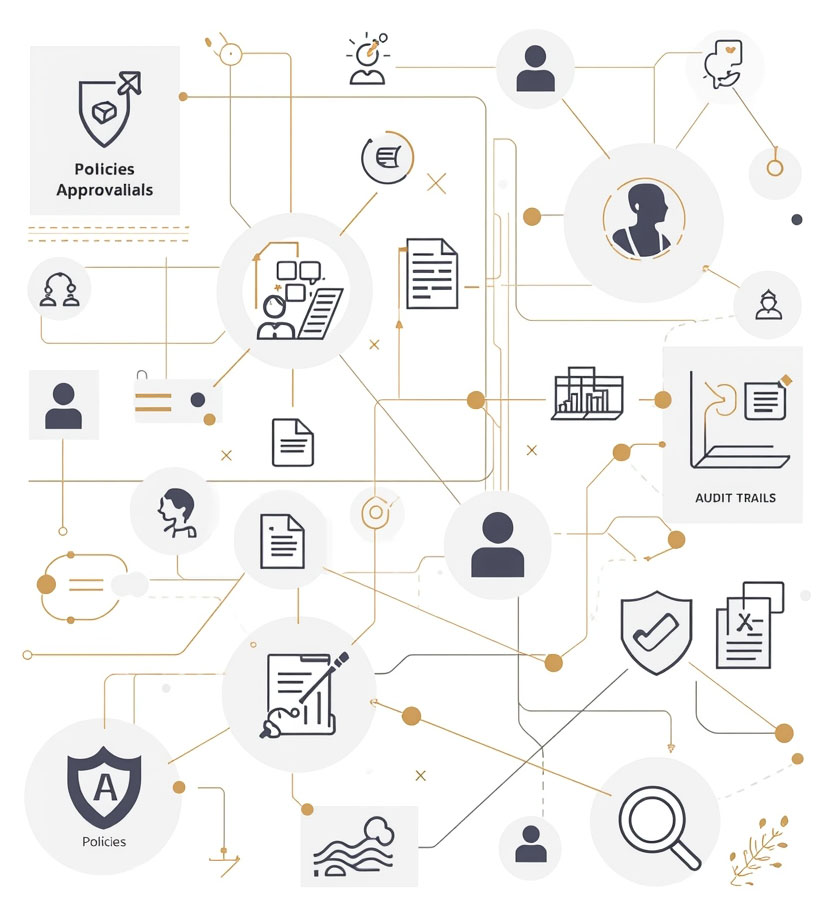
Policies guide workflows. Approvals authorize decisions. Evidence supports actions. Audit trails preserve accountability across the employee lifecycle.
Why this architecture matters
Many organizations discover governance gaps only when questions arise. GABE HRIS is designed to prevent those gaps by capturing accountability at the moment decisions are made.
Supports audits and investigations
Decisions can be reconstructed without relying on memory, spreadsheets, or disconnected systems. This reduces risk and accelerates response during audits and inquiries.
Reduces operational friction
Teams follow clear, policy-aligned workflows rather than improvising controls after issues surface.
Improves decision quality
When approvals and justifications are explicit, decisions become more consistent and defensible.
Scales with organizational complexity
Governance remains consistent as organizations grow, restructure, and operate across environments.
See how governance aligns to your environment
Governance requirements vary by organization and industry. Compare editions to understand how GABE HRIS adapts its governance architecture to commercial and federal environments.